
More than an inventory
The letter than travels with your will

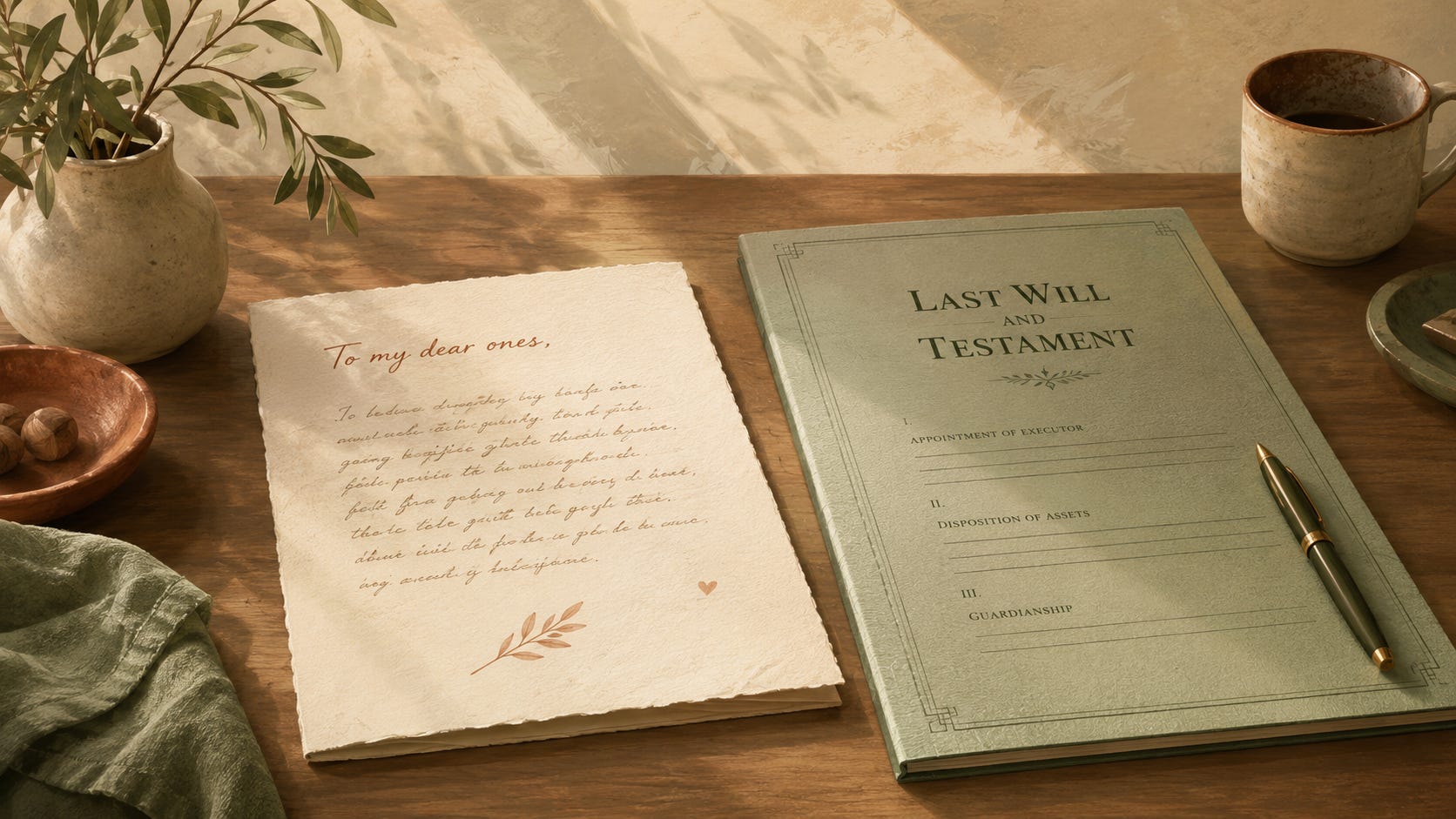
Most of us, when we finally sit down to think about a will, start with the same question: Who gets what?
But that question skips something deeper.
Before “who gets what,” there’s one most of us never think to ask: What has my life been about — and how do I want that to keep going when I’m gone?
That shift can change everything.
This post isn’t about the legal document itself. It’s about the emotional work that comes before — the thinking that clarifies what your will should say and why.
Some of that thinking directly shapes the legal language: who you name as executor, how you divide assets, who you trust to raise your children. The rest belongs in a personal letter — sometimes called a letter of intent — that travels alongside your will but stays private.
Both of these documents matter, but the thinking comes first.
From inventory to identity
Think about two wills.
In the first, three children each receive an equal share. Clean and simple.
In the second, the same three children receive the same equal shares. But attached is a short letter: “I chose equal shares because fairness has always mattered to me. I know your lives look different. But I want you to know I see you, and I love you equally.”
The numbers are the same. The experience is not. One feels like a formula. The other feels like a parent still speaking.
Most people never write that letter. Not because they don’t care, but because no one told them it was an option. We think of a will as a financial document, but underneath the legal language, it’s a record of who mattered to you and what you felt responsible for.
Your will is a portrait of your values.
What values look like in a will
You don’t need to call them “values.” You just need to notice what tugs at you when you think about the people you’d leave behind.
If that tug is your desire to show you care, it might shape how you choose a guardian. Maybe you skip over your most successful relative and choose the steadiest one. The person your children already feel safe with.
If you want to stress fairness, maybe equal shares are right. Or maybe fairness means unequal shares that reflect different needs. Pair that with a note explaining your choice, and no one will mistake it for favoritism.
If you want to show generosity, you could leave a gift to a shelter that helped you once, or a scholarship at the school that shaped your children.
When your will reflects what you actually care about, it stops feeling like paperwork and becomes something that feels like you.
More than money
Some of the things we treasure most are worth almost nothing on paper. A recipe card in your mother’s handwriting. A worn guitar. The family dog.
Your personal letter is where these things live. You might leave your toolbox to the friend who helped you rebuild your porch — and your confidence. You might write a few lines about your dog’s favorite hiding spot during thunderstorms, so whoever takes her in won’t have to guess. None of this belongs in the legal document. But it matters deeply to the people reading it.
Writing the “why,” not just the “what”
One of the most powerful things you can do is explain the reasons behind your choices. A few honest sentences can change how a decision lands years from now.
“I chose your aunt as guardian because I trust her steadiness, and I know she loves you.”
“I’ve left more to your brother because his health needs are greater right now. This is not a ranking of love.”
When the “why” is on paper, your family members are less likely to fill the silence with their own stories: She loved him more. He didn’t trust me. They forgot about me. Instead, they can see your reasoning. They don’t have to guess.
Estate planners generally recommend putting these explanations in the letter, not in the will. A will becomes public record once it enters probate, and anyone can read it. Reasons embedded in a will can also be scrutinized and used to challenge the document. A separate letter stays private, is easier to update, and gives you room to be personal in ways a legal form can’t.
A place to start
You don’t need a lawyer to begin this work, but it will help smooth the process if you do hire one later. For now, you only need a few quiet minutes and some honest questions:
What has my life been about, not the resume version, but the real one?
If my will could speak for me after I’m gone, what would I want it to say?
Is there something I hope the people I’m closest to will never have to guess about?
The legal part can come later. But this is the groundwork that gives it meaning.
And this emotional work will make the legal part easier, both for you and for the people you leave behind.
What a good idea, Sara. Because circumstances have changed, we need to re-do our will and we'll be guided by your post as we do so. Seems like not only family and friends would benefit from such a letter but recipient organizations as well. Potential blurb lines for their development campaigns, among other things! Along similar lines to your post, we also want to do something like this: https://www.hachettebookgroup.com/titles/barry-k-baines/ethical-wills/9780738210551/.
Another article, Sara, that will help thousands over the next few years. Thank you.